
Window and sliding door maintenance on the Spanish coast: a practical guide and calendar
Near the sea, windows work harder: salt settles on frames and hardware, the wind blows sand into the tracks and the sun dries out the seals. The good news is that looking after them is simple and cheap: water, mild soap, a brush, a few drops of oil and half an hour per window a few times a year. Late autumn is a good moment to do it: you clear what the summer left behind and get the windows ready for winter rain and wind.
Updated 26/11/2026
Why coastal windows need more care
Inland, a window can go for years with the odd clean. On the first or second line from the beach — Torrevieja, Orihuela Costa, Guardamar, Santa Pola — the air carries salt that sticks to everything. With the night-time humidity it forms a film that attacks poorly protected metal (screws, keeps, rollers) and marks the powder coating on aluminium. Add sand, and it works like sandpaper inside a sliding door track.
Neither uPVC nor coated aluminium "rusts" like iron, but the hardware does suffer, and a sliding door that is hard to push ends up with worn rollers. The care guides published by window profile manufacturers agree that cleaning frequency depends on exposure: the closer to the sea, the more often. We compare the two materials in uPVC or aluminium near the sea.
What you need
- Lukewarm water and mild, pH-neutral soap (diluted washing-up liquid is fine).
- Soft cotton or microfibre cloths and a non-scratch sponge.
- A small brush or paintbrush and a vacuum cleaner with a crevice nozzle for the tracks.
- Acid-free oil for the mechanisms (light machine oil or whatever the hardware maker recommends) and, for the seals, a rubber-care product or plain petroleum jelly.
What not to use: scouring pads, abrasive powders, bleach, ammonia, solvents, acetone or acidic cleaners. They scratch or dull the coating on aluminium and the surface of uPVC, and they dry out the seals. Don't aim a pressure washer at the seals and drain holes either: it forces water where it shouldn't go.
Step 1: frames and glass
Wet the frame and sashes with soapy water, rub gently and rinse with clean water so no salt or soap is left behind. Dry with a cloth. On sea-facing windows do it more often in summer, when there is more salt in the air, and always after an easterly storm. Clean the glass last, once the frame is done, so you don't smear it again.
If your uPVC windows have a wood-effect or coloured foil, treat them the same way: water and mild soap, nothing abrasive.
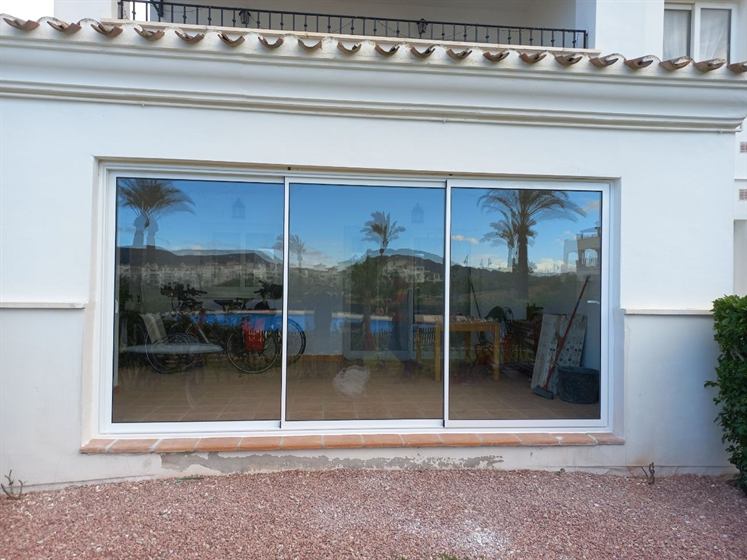
Step 2: sliding door tracks
This is the part that benefits most. Sand, leaves, pet hair and salt build up in the bottom track, so the sash gets stiff and the rollers wear.
- Open the sash fully and vacuum the track with the crevice nozzle.
- Go over the corners with the brush and wipe with a damp, soapy cloth.
- Slide the sash the other way and repeat for the section it was covering.
- Don't oil or grease the track: it traps sand and turns into paste. If the manufacturer says so, a light dry silicone spray is enough.
If the door is still stiff, scrapes or jumps out of the track after cleaning, the rollers probably need adjusting or replacing. That's a job for a fitter — don't force the sash.
Step 3: drain holes (the slots at the bottom)
The bottom of the frame has small drainage slots, sometimes with a little hinged cap on the outside. They let out the water that gets into the track when rain is driven by the wind. If they block, water sits in the track and eventually comes inside — one of the most common reasons for "water coming in under the sliding door". Before the autumn rains and after every storm, check them:
- Pour a glass of water into the track and check that it runs out outside.
- If it doesn't, clear the slot with a thin wire or a cotton bud, without enlarging it or breaking the cap.
What else to check before heavy rain is in our guide windows leaking in heavy rain (DANA).
Step 4: hardware and locks
Hinges, espagnolettes, locking points, keeps and rollers are moving metal parts, and salt stiffens them. Once they are clean and dry:
- Put one drop of acid-free oil on each moving point and on the locking cams, open and close a few times, and wipe off the excess.
- For door cylinders use a proper lock lubricant, not cooking oil.
- Check that the screws on hinges and handles are tight.
Hardware makers usually recommend oiling at least once a year; on the coast we suggest twice. If a tilt-and-turn sash drops, rubs the frame or won't close properly, the hinges need adjusting: follow the hardware manual or ask a professional, but don't leave it.
Step 5: rubber seals
The seals keep out draughts, water and noise. Clean them with soapy water only and, once a year, apply a thin layer of rubber-care product or petroleum jelly to keep them supple in the sun. A seal that is cracked, hard, flattened or out of its groove can be replaced without changing the window. A worn seal shows up as draughts and as condensation on the glass.
Step 6: shutters and fly screens
- Wash the slats of the roller shutter with soapy water and rinse: salt marks them too.
- Brush out the side guides; don't oil them, oil collects dust.
- If a motorised shutter makes odd noises or stops, don't force it: usually a limit switch needs resetting or a slat is caught.
- Clean roller fly screens pulled down, with a soft brush or vacuum, and let them dry before rolling them up.
More on shutter types in roller shutters: manual or motorised.
A simple yearly calendar
| When | What to do |
|---|---|
| Monthly (seafront) or every season (elsewhere) | Rinse frames with soapy water; vacuum the tracks. |
| September–October, before the rains | Test the drain holes with a glass of water; check the seals; make sure windows and shutters close properly. |
| November–December | Thorough clean after the summer; oil the hardware; treat the seals. |
| March–April | Check after the winter storms; oil the hardware again (coast); get fly screens ready. |
| After a storm (rain or easterly wind) | Rinse off the salt, empty the tracks and check the drain holes. |
| House closed for months | Clean before you leave, leave shutters down and drains clear; quick check when you come back. |
If your home stays empty over the winter, our guide on securing an empty holiday home has a checklist for locking up.
When repairing is no longer worth it
Good maintenance makes a window last much longer, but it doesn't work miracles. Replacing usually makes sense when:
- the aluminium is old, without a thermal break, and the glass streams with condensation every winter;
- the sliding door lets water in even with clean drains and new seals;
- the frames are warped, the glazing is single or spare parts no longer exist.
If so, see guide prices in our price table or work out your case with the online calculator. We make uPVC windows, aluminium windows and sliding doors in our own workshop in San Fulgencio, and we measure and fit in Torrevieja, Orihuela Costa, Guardamar, Alicante, Elche and nearby. We speak English.
Sources
- Cleaning and care manuals from window profile and hardware manufacturers (general recommendations: mild neutral soap, no abrasives or solvents; acid-free oil on moving parts at least once a year; more often in a marine environment).
- Consumer (in Spanish): looking after uPVC windows.
Frequently asked questions
How often should I clean windows near the sea?
On the seafront, rinsing the frames and vacuuming the tracks once a month is ideal; further inland once a season is enough. Always do it after a storm to remove the salt.
My sliding door is very stiff. Should I oil the track?
No. Oil in the track traps sand and makes things worse. Vacuum and clean the track; if it is still stiff, the rollers usually need adjusting or replacing.
What should I use to oil the hardware?
Acid-free oil (light machine oil or the lubricant the hardware maker recommends), one drop on each moving point. No cooking oil or thick grease.
Can I clean my windows with a pressure washer?
It isn't advisable: the jet forces water through the seals and drain holes and can damage the finish. Water, mild soap and a soft cloth are better.
Water comes in under the sliding door when it rains. What can I do?
Check the drain holes first: pour a glass of water into the track and see that it runs out outside. If they are clear and water still gets in, it may be the seal, the sealing around the frame or the design of the door itself; send us photos or a video.
Can the seals be replaced without changing the window?
Yes, on most windows the seal sits in a groove and can be replaced. If the window is very old and no spare exists, it is worth considering a full replacement.
Windows beyond saving?
Send us the sizes and a few photos: we'll give you a factory guide price for new windows and sliding doors built for the coast.