
Glass curtains in Spain: pros, cons and cost
A glass curtain is the lightest way to enclose a terrace: glass panels with no vertical frames that keep out wind and rain and, whenever you like, slide to one side and disappear. They suit the coast very well, but it pays to know what they do not do before you ask for a quote. Here is the full picture, with no small print.
Updated 16/11/2026
What exactly is a glass curtain?
A glass curtain (cortina de cristal in Spanish) has three parts: an aluminium track at the top, another at the bottom and, between them, panels of 10 mm toughened glass. There are no vertical frames between one panel and the next, only a slim clear seal. So with the curtain closed, the view stays almost exactly as it was.
The tracks are powder-coated in the colour you choose, usually the colour of the windows or the railing, so the enclosure hardly shows on the façade.
Two systems: folding and sliding
| Folding (slide-and-turn) | Sliding | |
|---|---|---|
| How it opens | Panels slide to one end, turn and stack side by side | Panels run on several parallel tracks and stack one behind another |
| Clear opening | The whole opening | Nearly all: the stacked panels take up one panel width |
| Shapes | Straight runs, corners, L and U shapes | Straight runs |
| Daily use | Panels are opened in order | Very easy: just push |
| Cleaning | Each panel turns inwards, so both faces are cleaned from the terrace | The outer face is cleaned from inside by sliding the panels, or from outside if you can reach it |
Which one? If the terrace turns a corner, or you want the opening completely clear in summer, choose folding. If it is a straight run that you will open and close several times a day, sliding is more practical. When we measure, we show you how each would look on your terrace.
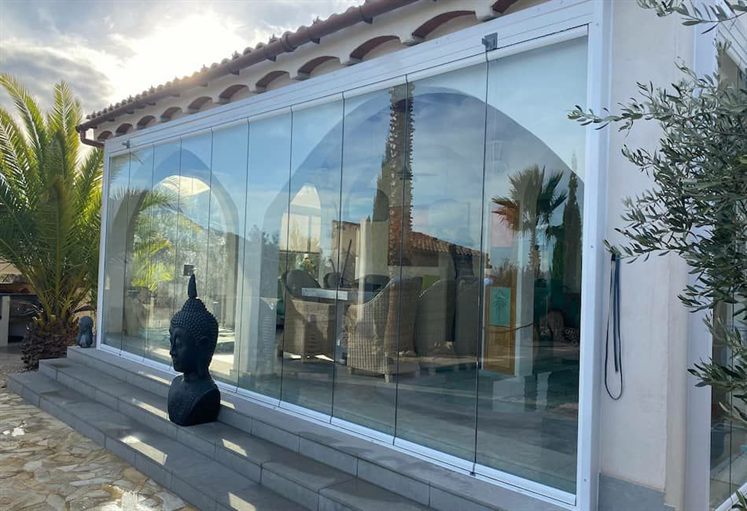
What it does well
- It stops the wind. The number one reason on the seafront and on upper floors: the terrace is no longer a place where the tablecloth takes off.
- It keeps the rain out. Furniture, cushions and the terrace floor stop getting soaked in every storm.
- It gains warmth from the sun. On a clear winter day the glass works like a greenhouse and the terrace warms up with no heating at all.
- It keeps out dust and sand, and a good share of the cleaning with them.
- It reduces street noise; it does not remove it, but you notice the difference.
- It does not block the view and opens fully when the weather is fine.
What it does not do (worth knowing first)
- It does not insulate like a window. It is single glass with no air gap. At night the terrace temperature gets close to the temperature outside.
- It is not airtight. A small gap remains between the panels. In heavy rain with the wind straight on, a little fine spray can get through; the bottom track has drainage holes for that, and they need to be kept clear.
- It does not replace the window or sliding door of the living room. It is a second skin in front of the house, not the closure of the home. Security still depends on the doors and windows behind it.
- Closed and in full summer sun, it traps heat. The fix is simple: open it. If the terrace faces south or west, combine it with an awning or ask for tinted glass.
If what you want is an extra room that stays warm at night too, you need a double-glazed sliding door. We compare the two in the guide glass curtain or sliding door.
Wind, rain and salt air: how it behaves on the coast
Toughened glass is several times stronger than ordinary glass of the same thickness and, if it ever breaks, it crumbles into small blunt granules rather than sharp shards. In strong wind the glass is only part of the story: the tracks matter and, above all, what they are screwed into. That is why we look at the terrace ceiling and wall before making anything: a plasterboard false ceiling or a loose parapet will not do as a fixing point, and we have to reach the concrete slab or reinforce.
The taller the panel and the more exposed the terrace (a penthouse, a corner facing the sea), the more this matters. There is no single rule: it is decided when we measure.
Salt does not harm the glass, but it builds up in the tracks and rollers. A rinse with fresh water now and then makes the system last much longer. More advice in the guide PVC or aluminium near the sea and, for storm days, in windows and DANA storms.
Options to decide on
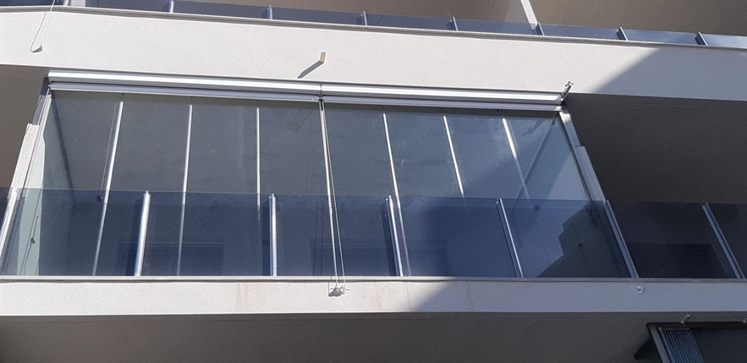
- Surface-mounted or recessed bottom track. A surface-mounted track is screwed on top of the floor and leaves a small step; a recessed one sits flush, but a channel has to be cut into the tiles. If you are about to retile the terrace, that is the moment to recess it.
- On the floor or on the wall. The curtain can run floor to ceiling or sit on the low terrace wall.
- Clear or tinted glass. Tinted glass cuts glare and gives a little privacy; clear glass is the least noticeable.
- Knob or handle and a lock on the access panel, if the terrace can be reached from the garden or the street.
- Track colour, to match the windows or the railing.
Cleaning and upkeep
- Glass: water with mild soap and a squeegee, like any other pane.
- Bottom track: vacuum out sand and leaves every few weeks. Nothing does more for the life of the rollers, and it keeps the drainage holes open.
- By the sea: rinse tracks and fittings with fresh water, especially after an easterly storm.
- Ventilate. A closed terrace with laundry or plants collects moisture and the glass mists up inside. Opening one panel for a while each day solves it. We explain why in window condensation.
- If a panel starts to feel stiff or to rub, call us: it is usually a few minutes' adjustment, and forcing it is what ends up damaging the part.
Do you need permission?
In a building or an urbanisation, generally yes. Even though the curtain opens fully, when closed it changes the façade, and that requires the agreement of the community of owners and whatever procedure your town hall asks for. Many communities already have an approved model and colour: ask the administrator before you order anything. We give you the drawing and technical sheet to submit. Full details in the guide permission to enclose a terrace.
What drives the cost
Glass curtains are priced per square metre, but there is no one figure that fits every terrace. The price changes with:
- the width in metres and the height of the panels;
- the system: folding or sliding;
- the number of corners and sections;
- the bottom track (surface-mounted or recessed) and the trims against walls and ceiling;
- the options: tinted glass, lock, colour;
- access: a ground floor is not the same as a penthouse where the glass has to be carried up.
That is why we prefer to give you a fixed price after seeing the terrace rather than publish a “from” price that does not hold. If you are comparing offers, the guide on comparing quotes tells you what should be in writing, and our factory prices list windows and sliding doors in case you want to weigh up the alternative.
What to ask for in the quote
- The system (folding or sliding) and the number of panels.
- The glass thickness and type: 10 mm toughened, clear or tinted.
- The bottom track: surface-mounted or recessed, and who cuts the channel if it is recessed.
- Where the top track is fixed and whether reinforcement is needed.
- That it includes measuring, fitting and trims, and the delivery time.
How we help
- We prepare your glass curtain to measure in our workshop in San Fulgencio and our own team fits it. See examples in our projects.
- Free measuring visit within 30 km of the workshop and a fixed price after measuring.
- We work in Torrevieja, Orihuela Costa, Guardamar, Santa Pola, Alicante and the Murcia coast. We speak English.
Frequently asked questions
Does water get in when it rains?
In ordinary rain, no. In heavy rain with the wind straight on, some fine spray can pass through the joints, because a glass curtain is not airtight. The bottom track has drainage holes to let it out; keep them clean.
Will it stand up to coastal wind?
Yes, if it is properly sized and anchored. The glass is 10 mm toughened; what really counts is where the tracks are fixed. On penthouses and very exposed corners we study it more carefully when we measure.
Does the terrace get warm in winter?
By day and in the sun, very. At night, not much: it is single glass and the temperature gets close to the outside. For a room that is warm at all hours you need a double-glazed sliding door.
Is it safe with children?
Toughened glass is very resistant to knocks and, if it breaks, it does so in blunt granules. Bear in mind that a glass curtain is not a railing: if the terrace is above ground, protection against falls is still the existing wall or railing.
Can it go on top of my existing wall or railing?
On a solid masonry wall, normally yes. On a metal railing it depends on its condition and how it is anchored; we assess it when we measure.
How much do glass curtains cost in Spain?
They are priced per square metre according to the system, the size, the corners and the options. Send us the width, the height and a photo and we will give you a guide price.
How would it look on your terrace?
Send us the width, the height and a couple of photos of the terrace on WhatsApp: we will tell you which system fits best and what it costs.